
On 23 June 2026 HMRC published its 2026 edition of Measuring tax gaps. Within a day the figure had been rounded, subtracted and headlined across the trade press, and by the end of the week most practitioners had absorbed a single sentence: the tax gap grew by £6.4 billion.
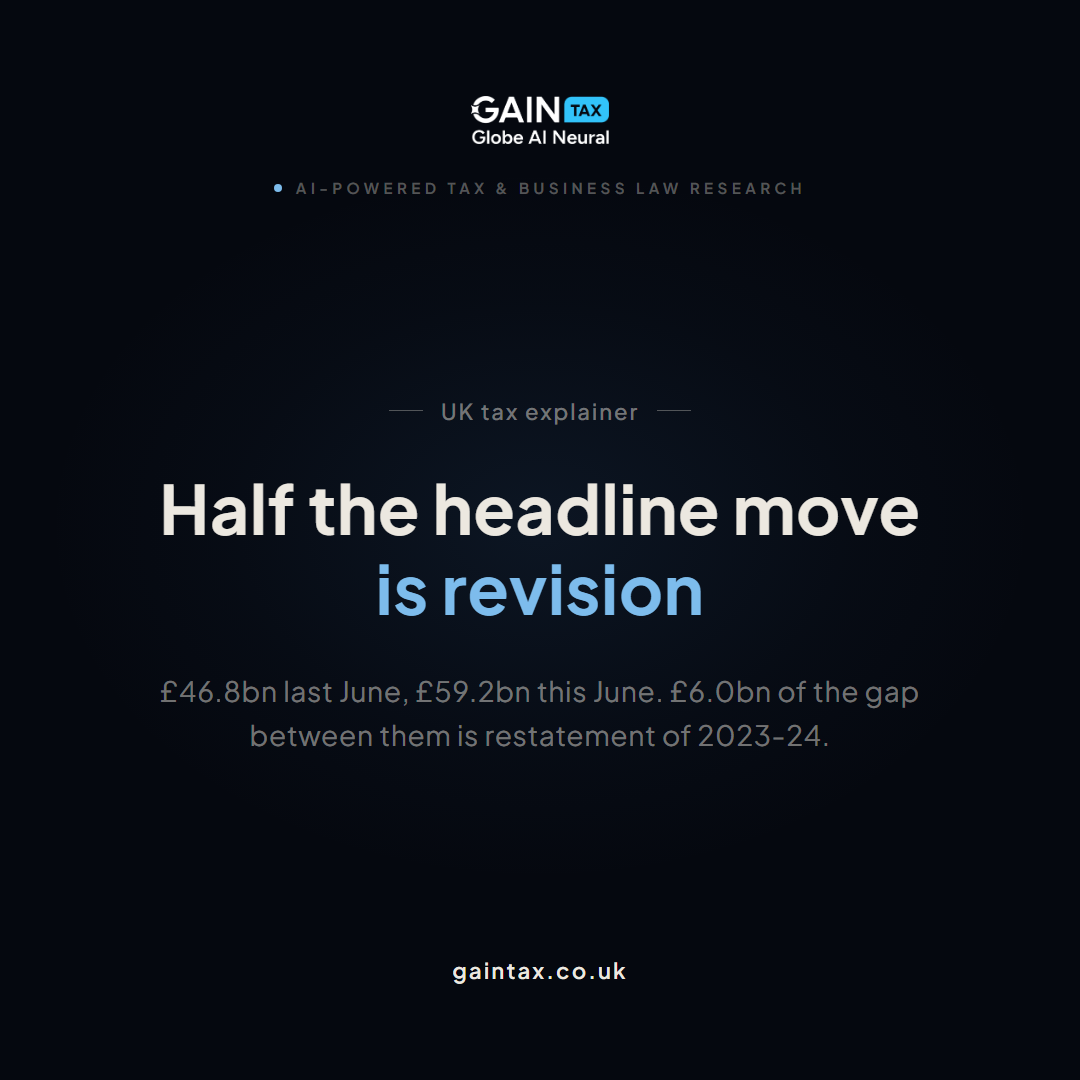
That sentence is arithmetically right and tells less than half the story. The £6.4 billion is the movement from a 2023-24 figure that HMRC restated in the same announcement, from £46.8 billion to £52.8 billion. A reader who remembers last June's number and reads this June's sees a gap of £12.4 billion, and roughly half of that is revision rather than behaviour.
The distinction matters less as a point of pedantry than as a warning about how the rest of the publication gets read. Underneath the headline sit two facts that change what a practice should take from the release: where the estimate is concentrated, and how confident HMRC says it is about the part that carries the most weight.
Key takeaways
- HMRC's 2026 edition puts the 2024-25 tax gap at "6.4% of total theoretical tax liabilities, or £59.2 billion in absolute terms", on a provisional basis.
- Small businesses account for 62% of the tax gap, "up from 58% in 2020 to 2021" by customer group.
- The share of the estimate carrying HMRC's own "high" uncertainty rating "has increased to around a third (35%), up from around 8%" in the previous edition.
- HMRC attributes that movement to "small businesses Corporation Tax moving from the 'medium' to the 'high' category", a change in measurement confidence rather than a finding about behaviour. The same release notes that "around half of the small business tax gap is for Corporation Tax", so the least certain component is also the largest.
- A 62% share describes where an estimate is concentrated. It is not a probability that any individual client will be enquired into, and it should never be presented to a client as one.
- The part of this a practice controls is evidential: records that answer the question the first time, assembled before anybody asks.
What HMRC published in June 2026
The headline figure
The 2026 edition estimates the 2024-25 tax gap at 6.4% of total theoretical tax liabilities, which HMRC expresses in cash terms as £59.2 billion. Both halves of that sentence matter. The percentage is the measure HMRC treats as primary, because it holds the estimate steady against a tax base that grows year on year. The cash figure is the one that travels, because £59.2 billion is a number a reader can picture and 6.4% is not.
The increase, and the revision underneath it
HMRC's release states the restatement plainly: "In line with standard practice, previous years' tax gap estimates have been amended as part of today's announcement, including revising upwards the provisional tax gap estimate for 2023 to 2024, published last year, from 5.3% (£46.8 billion) to 6.0% (£52.8 billion)." Set the new provisional figure of £59.2 billion against the restated £52.8 billion and the increase is £6.4 billion, or 0.4 percentage points. That is the like-for-like movement, and it is the number the trade press quoted.
What the headline leaves out is the size of the restatement itself. Moving 2023-24 from £46.8 billion to £52.8 billion added £6.0 billion to last year's number before any 2024-25 behaviour was counted. Revisions are a standard feature of the series, as fuller data arrives from random enquiry programmes and as methods change, and HMRC does not write the sentence "the gap grew by £6.4 billion" itself: it publishes the level and the restatement and leaves the subtraction to the reader.
Before repeating a year-on-year tax gap movement to a client or in a submission, say which comparator it uses. Against the restated 2023-24 figure the increase is £6.4 billion; against the figure published last June it is £12.4 billion, and £6.0 billion of that is revision. The two numbers describe different things, and only one of them is about behaviour.
Provisional means provisional
The 2024-25 estimate is provisional. It will be restated in the 2027 edition as more complete compliance data arrives. Anyone building an argument that depends on the precise size of this year's figure is building on a number that HMRC has already flagged as unfinished.
Where the gap sits: the customer-group split
Small business at 62%
By customer group, HMRC reports that small businesses accounted for 62% of the tax gap in 2024-25, up from 58% in 2020-21. That is the single most quoted line in the release and the one most often misread.
Reading a share correctly
A share tells you how an estimate is distributed. It says that of the total HMRC believes goes uncollected, roughly three pounds in five are attributed to the small business population. It does not say that three in five small businesses are non-compliant, that any particular client sits inside the estimate, or that an individual practice's client base resembles the national distribution.
The small business population is also enormous. A large share spread across millions of taxpayers describes a different world from the same share concentrated in a few hundred.
Why the share moved
A share can move because the numerator grew, because another group's contribution shrank, or because the method for estimating one component changed. The 2026 edition contains an example of the third case, and it is the most consequential thing in the publication.
The uncertainty rating almost nobody reads
How HMRC grades its own estimates
HMRC publishes an uncertainty rating alongside its components, marking each as carrying low, medium or high uncertainty. The rating is a statement about the quality of the estimate, made by the people who produced it. It is the closest thing in the publication to an audit opinion on its own numbers.
From around 8% to around a third
In this edition, the share of the tax gap carrying a "high" uncertainty rating has increased to around a third, at 35%, up from around 8% in the 2025 edition. That is not a small technical adjustment. In a single year, the proportion of the estimate that HMRC describes as least reliable has more than quadrupled.
The stated driver is small businesses Corporation Tax moving from the medium category to the high one.
"A third of the estimate now carries HMRC’s own lowest confidence rating."
What a high rating changes about the argument
Put the two facts side by side. Small business is 62% of the estimate. The reclassification that pushed a third of the estimate into the "high" uncertainty band is a small business component, specifically small businesses Corporation Tax. The customer group carrying most of the headline is therefore also the group supplying the estimate HMRC has become least sure of. Those are overlapping populations rather than the same figure, and the distinction is worth keeping when the point is repeated.
That is a reason to handle the composition carefully, and it is emphatically not a reason to dismiss it. An estimate flagged as uncertain is still the estimate that resourcing decisions and policy arguments get built on.
In practice: When a client asks whether "HMRC says small businesses are evading more", the accurate answer is that HMRC's published commentary attributes the movement in these estimates to measurement, not to a finding about behaviour. The statistics contain no behavioural explanation, and supplying one on HMRC's behalf is an error a well-read client will catch.
What this does and does not say about enquiry odds
A share is not a probability
No line in Measuring tax gaps supports a statement about the likelihood that a named taxpayer will be enquired into. The publication estimates aggregate non-compliance. It publishes no per-client risk score, and it does not support the derivation of one.
Any adviser tempted to convert 62% into a client-facing probability should notice how quickly that framing collapses under a question from an informed client: 62% of what, measured how, and with what confidence.
Resourcing follows the estimate
The honest connection between the statistics and a practice's workload runs through resourcing. Where an estimate concentrates, compliance attention tends to follow, because that is where a department believes the recoverable money sits. That is a directional statement about departmental behaviour over years, not a prediction about next spring.
The honest version, in one sentence
The composition describes where the system's attention is pointed, at the level of a population. Which of your clients receives a letter is decided somewhere else entirely.
What a practice should actually do
The part of this within a firm's control is evidential, and it is unglamorous. When an enquiry does arrive, the argument is shortened by records that answer the question the first time.
The three questions a file should survive
- Can you show the figure's origin? Not the spreadsheet that totals it, the document that generated it. A bank line, an invoice, a contract, a mileage log.
- Can you show the judgement, dated? Where a treatment involved a decision, is the reasoning recorded at the time it was made rather than reconstructed afterwards?
- Can you produce it without the client? A file that depends on a director's memory is a file with a single point of failure.
A worked example
A sole trader with £180,000 of turnover claims £14,000 of motor and travel costs. Two firms hold two files.
The first holds a summary schedule and a folder of receipts. Answering a simple opening enquiry means a fortnight of reconstruction, three client calls and a best estimate of business use.
The second holds the same receipts, a contemporaneous mileage record, and a dated one-page note from the year the vehicle was bought explaining the 80% business-use judgement and how it was arrived at. The response is a covering letter and an attachment.
Both clients may be equally compliant. Only one of them has an inexpensive enquiry.
Key date: Measuring tax gaps is published annually in June. The 2027 edition will restate the 2024-25 provisional figure used throughout this article. Diarise a review of any client-facing material that quotes it.
Where an AI research tool fits, and where it does not
A research tool shortens the legal half of an enquiry response: finding the provision, the guidance and the case that settle the treatment, with citations that resolve to the source. It does nothing about the evidential half, which is the half most enquiries actually turn on. Tools that present themselves as a substitute for the file are selling the wrong half of the problem. Our own published benchmark methodology exists precisely so that the legal half can be checked rather than trusted, and our limitations and responsible use page is candid about where the boundary sits.
If you want to see how a cited answer behaves on a real enquiry point, create a free account and run one of your own open questions through it.
Conclusion
The 2026 edition of Measuring tax gaps gave the profession one number and three pieces of context, and the number travelled alone. The context is more useful: the £6.4 billion increase sits on a 2023-24 figure that was itself revised up by £6.0 billion in the same release, the 62% small business share describes concentration rather than culpability, and the uncertainty rating on a third of the estimate is an unusual piece of candour from a statistical publication.
For a practice, none of this changes the work. It sharpens the reason for it. The estimate points departmental attention at a population; the file decides what happens when that attention arrives. Build the file on the assumption that the question will be asked by someone who was not there.
For a broader view of how to assess the research tools that support this kind of work, our guide on how to choose AI tax research software in the UK sets out the criteria worth applying, and the sources and update policy explains how currency of law is maintained. Firms weighing this across several seats can book a call.
Frequently asked questions
What is the UK tax gap for 2024-25?
HMRC's 2026 edition of Measuring tax gaps, published on 23 June 2026, estimates the 2024-25 tax gap at 6.4% of total theoretical tax liabilities, which it expresses as £59.2 billion in absolute terms. The estimate is provisional and will be restated in a later edition as more complete compliance data becomes available.
Did the UK tax gap grow by £6.4 billion?
On a like-for-like basis, yes. HMRC's 2026 release restates the 2023-24 estimate from £46.8 billion to £52.8 billion, and the new provisional figure of £59.2 billion is £6.4 billion above the restated one. HMRC does not itself write that sentence, and the restatement alone added £6.0 billion to last year's published number, so a reader comparing the two June headlines sees £12.4 billion of which roughly half is revision rather than a change in behaviour.
What share of the tax gap do small businesses account for?
HMRC reports that small businesses accounted for 62% of the tax gap in 2024-25, up from 58% in 2020-21. This describes how the aggregate estimate is distributed across customer groups. It is not a statement about the proportion of small businesses that are non-compliant, and it does not translate into a risk score for any individual taxpayer.
What does the "high uncertainty" rating on the tax gap mean?
HMRC grades the reliability of its own component estimates as carrying low, medium or high uncertainty. In the 2026 edition the share of the tax gap carrying a high rating increased to around a third, at 35%, up from around 8% in the previous edition, with small businesses Corporation Tax moving from the medium to the high category.
Does a larger tax gap mean more HMRC enquiries for my clients?
No published line supports that inference for an individual client. The connection runs through resourcing: compliance attention tends, over time, towards populations where an estimate concentrates. That is a directional observation about departmental priorities across years, not a prediction about any particular taxpayer or filing season.
How should a practice prepare for enquiry activity?
Concentrate on evidence rather than on forecasting. For each material figure, be able to show the source document, a dated note of any judgement behind the treatment, and a file that can be produced without relying on a client's recollection. Contemporaneous records shorten an enquiry far more reliably than any attempt to predict who receives one.